
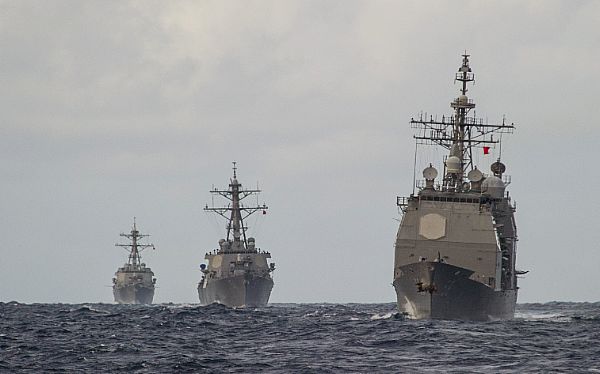
AEGIS equipped US Navy cruisers and destroyers are one of the most capable ships in the world. (Photo: US Navy)
By: Stephen Ellis (www.thediplomat.com)
Often overlooked in the debates about the possibility of a future struggle between the United States and China in East Asia is the fact that the current U.S. military presence in the region actually serves and supports a number of critical Chinese strategic interests. Beijing actually benefits in a number of ways from U.S. power, suggesting that the contention that China is ultimately seeking to push the United States militarily out of the region may not be as clear cut as is often assumed and asserted.
Often overlooked in the debates about the possibility of a future struggle between the United States and China in East Asia is the fact that the current U.S. military presence in the region actually serves and supports a number of critical Chinese strategic interests. Beijing actually benefits in a number of ways from U.S. power, suggesting that the contention that China is ultimately seeking to push the United States militarily out of the region may not be as clear cut as is often assumed and asserted.
Limiting Japan’s Conventional Power
The United States security commitment to Japan has for over six decades allowed Tokyo to “free ride” on U.S. military power in East Asia, and this has meant that Japan has not built up a conventional military capability in keeping with the size and wealth of its economy. Whilst Japan is undoubtedly today an important military actor within the region, it is highly likely that it would possess far greater conventional military capabilities were it not for the credible security guarantee provided to Japan by the strong U.S. military presence in the region. Whilst Japanese free-riding may or may not serve U.S. interests, the fact that the U.S. security guarantee has served to limit the size and power of Japan’s conventional military is highly beneficial for Beijing, given China and Japan’s history of hostility and conflict, current territorial disputes and their growing competition to be the lead East Asian nation.
If in the future China was to somehow succeed in driving the United States militarily out of East Asia, Tokyo would likely respond to diminishing U.S. regional power by significantly bolstering its own conventional military capabilities. For China, this would be something of a pyrrhic victory, as Beijing would have only succeeded in replacing the U.S. presence with growing Japanese military power, something China would likely view as a much more significant threat. Thus, pushing the United States militarily out of the East Asia may prove to be of questionable value to Beijing and could even worsen China’s strategic position with regard to Japan.
Given this, Beijing may instead look to continue to rise and operate within the existing regional framework built and maintained by the deployment of significant U.S. military power, which has so far proved highly effective at limiting Japan’s conventional military capabilities and aspirations.
Nuclear Proliferation
U.S. military power and its security commitments in East Asia can be seen as a critical factor in explaining why Japan, South Korea and Taiwan have not become nuclear actors and why there is little likelihood of Tokyo, Seoul or Taipei pursuing a latent or actual nuclear capability in the near future. In the case of Japan and South Korea, the fact that both states are protected by U.S. defense treaties and the U.S. nuclear umbrella has meant that neither Tokyo nor Seoul currently consider it necessary or in their interests to seek to acquire an independent nuclear capability, despite their challenging security environments.
In the 1970s and the 1980s, the United States used its significant diplomatic and military ties and leverage with Taipei to shut down Taiwan’s nuclear program on two separate occasions. The fact that Taipei has seemingly abandoned any ambitions to pursue an actual or latent nuclear capability can principally be seen as resulting from the U.S. security commitment and Washington’s clear and forcefully demonstrated opposition.
The fact that U.S. power has helped to prevent each of these actors from seeking to become nuclear powers is strategically beneficial for China. If any of its East Asian neighbors possessed a nuclear capability or were seriously pursuing one, China’s already challenging and complex security environment would be that much more complicated. It would also heighten the risk of China being affected by a nuclear crisis or accident and would also increase the possibility of Beijing being drawn into nuclear diplomacy or destabilizing acts of nuclear brinkmanship. Further, if Taiwan had succeeded in achieving a nuclear deterrent it would have essentially ended Beijing’s ability to reassert control over the island and instead made it highly probable that Taipei would have used the security provided by its nuclear capability to declare independence.
So the fact that U.S. power has served to dampen down the possibility of nuclear proliferation in East Asia has produced real and significant strategic dividends for Beijing, including with regard to its core interests relating to Taiwan. This demonstrates a further area of overlap between U.S. and Chinese interests in the region, and again shows how the U.S. military presence in East Asia does not automatically equate to a challenge or threat to Chinese interests, and indeed provides further reason to think that China may not necessarily look to drive Washington militarily out of East Asia.
Open Sea Lanes
U.S. naval power in East Asian waters, and the wider Indian and Pacific Oceans, has and does greatly benefit China both economically and strategically. The long-standing and unswerving U.S. commitment to open and stable sea lanes – and its ability to maintain them – has helped support and facilitate China’s spectacular economic rise since the 1980s. Today, not only do Chinese exports move freely across stable sea lanes guaranteed by U.S. power, but so do ever growing quantities of vital Chinese energy imports from the Middle East, Africa and Latin America.
This fact alone provides the clearest example of how China benefits from a strong U.S. military presence in East Asia. It is also the strongest reason why in the future Beijing may not consider it to be in its interests to try to weaken and diminish the U.S. military presence in East Asia. If the U.S. was forced to relinquish its role as guarantor of open and stable regional sea lanes, then Beijing would be forced to try to step into the breach, given that its economic model is so reliant on uninterrupted maritime trade. This would entail significant costs, and for now at least there is not much evidence to suggest that Beijing is willing or able to take on the burden of ensuring that East Asia’s vast and numerous maritime trade routes remain open and secure.
Even if Beijing were willing to replace the United States as the guarantor of open sea lanes in East Asia, other states in the region – notably Japan – would likely baulk at the prospect, and would either individually or collectively seek to fill the power vacuum. The result would be an increase in defense outlays by states across the region and a possible naval race between major East Asian states that could potentially disrupt maritime trade. Naturally, both of these developments would be unwelcome and troubling for Beijing.
Beijing today benefits enormously from open regional sea lanes without having to bear the diplomatic, fiscal and military costs of maintaining them. It would seem a real possibility that China might prefer to see the U.S. continue to carry the significant costs of providing this regional public good.
Clearly, the significant U.S. military presence in East Asia advances a number of core Chinese strategic interests. Thus, the belief that Beijing and Washington are heading almost inevitably toward strategic competition may not be as robust as is often assumed and asserted. This is not to say that the factors discussed here guarantee harmony between the two powers, but they do demonstrate that whilst there may well be factors pushing the U.S. and China toward competition, there are also real and important factors that favor more cooperative relations. (The Diplomat)
Stephen Ellis is a doctoral candidate at the University of Leicester.
The United States security commitment to Japan has for over six decades allowed Tokyo to “free ride” on U.S. military power in East Asia, and this has meant that Japan has not built up a conventional military capability in keeping with the size and wealth of its economy. Whilst Japan is undoubtedly today an important military actor within the region, it is highly likely that it would possess far greater conventional military capabilities were it not for the credible security guarantee provided to Japan by the strong U.S. military presence in the region. Whilst Japanese free-riding may or may not serve U.S. interests, the fact that the U.S. security guarantee has served to limit the size and power of Japan’s conventional military is highly beneficial for Beijing, given China and Japan’s history of hostility and conflict, current territorial disputes and their growing competition to be the lead East Asian nation.
If in the future China was to somehow succeed in driving the United States militarily out of East Asia, Tokyo would likely respond to diminishing U.S. regional power by significantly bolstering its own conventional military capabilities. For China, this would be something of a pyrrhic victory, as Beijing would have only succeeded in replacing the U.S. presence with growing Japanese military power, something China would likely view as a much more significant threat. Thus, pushing the United States militarily out of the East Asia may prove to be of questionable value to Beijing and could even worsen China’s strategic position with regard to Japan.
Given this, Beijing may instead look to continue to rise and operate within the existing regional framework built and maintained by the deployment of significant U.S. military power, which has so far proved highly effective at limiting Japan’s conventional military capabilities and aspirations.
Nuclear Proliferation
U.S. military power and its security commitments in East Asia can be seen as a critical factor in explaining why Japan, South Korea and Taiwan have not become nuclear actors and why there is little likelihood of Tokyo, Seoul or Taipei pursuing a latent or actual nuclear capability in the near future. In the case of Japan and South Korea, the fact that both states are protected by U.S. defense treaties and the U.S. nuclear umbrella has meant that neither Tokyo nor Seoul currently consider it necessary or in their interests to seek to acquire an independent nuclear capability, despite their challenging security environments.
In the 1970s and the 1980s, the United States used its significant diplomatic and military ties and leverage with Taipei to shut down Taiwan’s nuclear program on two separate occasions. The fact that Taipei has seemingly abandoned any ambitions to pursue an actual or latent nuclear capability can principally be seen as resulting from the U.S. security commitment and Washington’s clear and forcefully demonstrated opposition.
The fact that U.S. power has helped to prevent each of these actors from seeking to become nuclear powers is strategically beneficial for China. If any of its East Asian neighbors possessed a nuclear capability or were seriously pursuing one, China’s already challenging and complex security environment would be that much more complicated. It would also heighten the risk of China being affected by a nuclear crisis or accident and would also increase the possibility of Beijing being drawn into nuclear diplomacy or destabilizing acts of nuclear brinkmanship. Further, if Taiwan had succeeded in achieving a nuclear deterrent it would have essentially ended Beijing’s ability to reassert control over the island and instead made it highly probable that Taipei would have used the security provided by its nuclear capability to declare independence.
So the fact that U.S. power has served to dampen down the possibility of nuclear proliferation in East Asia has produced real and significant strategic dividends for Beijing, including with regard to its core interests relating to Taiwan. This demonstrates a further area of overlap between U.S. and Chinese interests in the region, and again shows how the U.S. military presence in East Asia does not automatically equate to a challenge or threat to Chinese interests, and indeed provides further reason to think that China may not necessarily look to drive Washington militarily out of East Asia.
Open Sea Lanes
U.S. naval power in East Asian waters, and the wider Indian and Pacific Oceans, has and does greatly benefit China both economically and strategically. The long-standing and unswerving U.S. commitment to open and stable sea lanes – and its ability to maintain them – has helped support and facilitate China’s spectacular economic rise since the 1980s. Today, not only do Chinese exports move freely across stable sea lanes guaranteed by U.S. power, but so do ever growing quantities of vital Chinese energy imports from the Middle East, Africa and Latin America.
This fact alone provides the clearest example of how China benefits from a strong U.S. military presence in East Asia. It is also the strongest reason why in the future Beijing may not consider it to be in its interests to try to weaken and diminish the U.S. military presence in East Asia. If the U.S. was forced to relinquish its role as guarantor of open and stable regional sea lanes, then Beijing would be forced to try to step into the breach, given that its economic model is so reliant on uninterrupted maritime trade. This would entail significant costs, and for now at least there is not much evidence to suggest that Beijing is willing or able to take on the burden of ensuring that East Asia’s vast and numerous maritime trade routes remain open and secure.
Even if Beijing were willing to replace the United States as the guarantor of open sea lanes in East Asia, other states in the region – notably Japan – would likely baulk at the prospect, and would either individually or collectively seek to fill the power vacuum. The result would be an increase in defense outlays by states across the region and a possible naval race between major East Asian states that could potentially disrupt maritime trade. Naturally, both of these developments would be unwelcome and troubling for Beijing.
Beijing today benefits enormously from open regional sea lanes without having to bear the diplomatic, fiscal and military costs of maintaining them. It would seem a real possibility that China might prefer to see the U.S. continue to carry the significant costs of providing this regional public good.
Clearly, the significant U.S. military presence in East Asia advances a number of core Chinese strategic interests. Thus, the belief that Beijing and Washington are heading almost inevitably toward strategic competition may not be as robust as is often assumed and asserted. This is not to say that the factors discussed here guarantee harmony between the two powers, but they do demonstrate that whilst there may well be factors pushing the U.S. and China toward competition, there are also real and important factors that favor more cooperative relations. (The Diplomat)
Stephen Ellis is a doctoral candidate at the University of Leicester.
 RSS Feed
